Adults aged 30-50: professionals and entrepreneurs who need Finnish for work, travel or personal development.
ACADEMIC TEAM PROJECT · APRIL 2025
PRODUCT DISCOVERY / FINNISH LEARNING
PECTO®
A Finnish learning app concept: from audience research to an AI-supported speaking practice flow.
Product discoveryUser researchAI learning
Context00
Learn between commitments and start speaking.
A team project exploring how busy adults could learn Finnish at a flexible pace and use it in practical situations. The materials include research synthesis, competitor analysis, product concept, interface prototype, metrics and a development plan.
Limited time for regular classes, difficulty maintaining motivation, too little speaking practice and trouble retaining new material.
↗ Key insight
Speaking practice is identified as a user priority in the research materials. The format should be short, flexible and connected to everyday situations.
01 / RESEARCH
From everyday barriers to a product opportunity.
The team grouped observations across user behaviour, learning context, content preferences, goals, progress, motivation and willingness to pay.
Daily rhythm
Most study in the evening or late at night; busy schedules and distractions get in the way of consistency.
Format
Short lessons, flexible timing and access across mobile and desktop matter.
Practice
Spoken Finnish, pronunciation and skills for real situations are priorities.
Motivation
Learners want to see personal progress and understand how study helps them communicate.
Context
Cultural topics and current content are appealing; learning should connect to real life.
Payment
Materials mention a willingness-to-pay range of RUB 500-1,000; this is a research observation, not a validated price.
Product opportunity
Make speaking practice practical and lightweight enough to fit into a busy day.
→02 / PRODUCT CONCEPT02
Speaking practice shaped around real situations.
The presentation describes a situational AI simulator. A learner selects or suggests a situation; the app proposes a topic based on context, listens through the microphone and adapts difficulty. GPT‑4 and Google Speech-to-Text are listed as concept technologies.
Scenarios
Dialogues for everyday situations: a meeting, a trip or a conversation.
Flexible format
Short sessions that learners can start at a convenient time.
Support
Flashcards and dictionary, a content library and visible progress.
Personalization
Professions, events and interests shape learning topics.
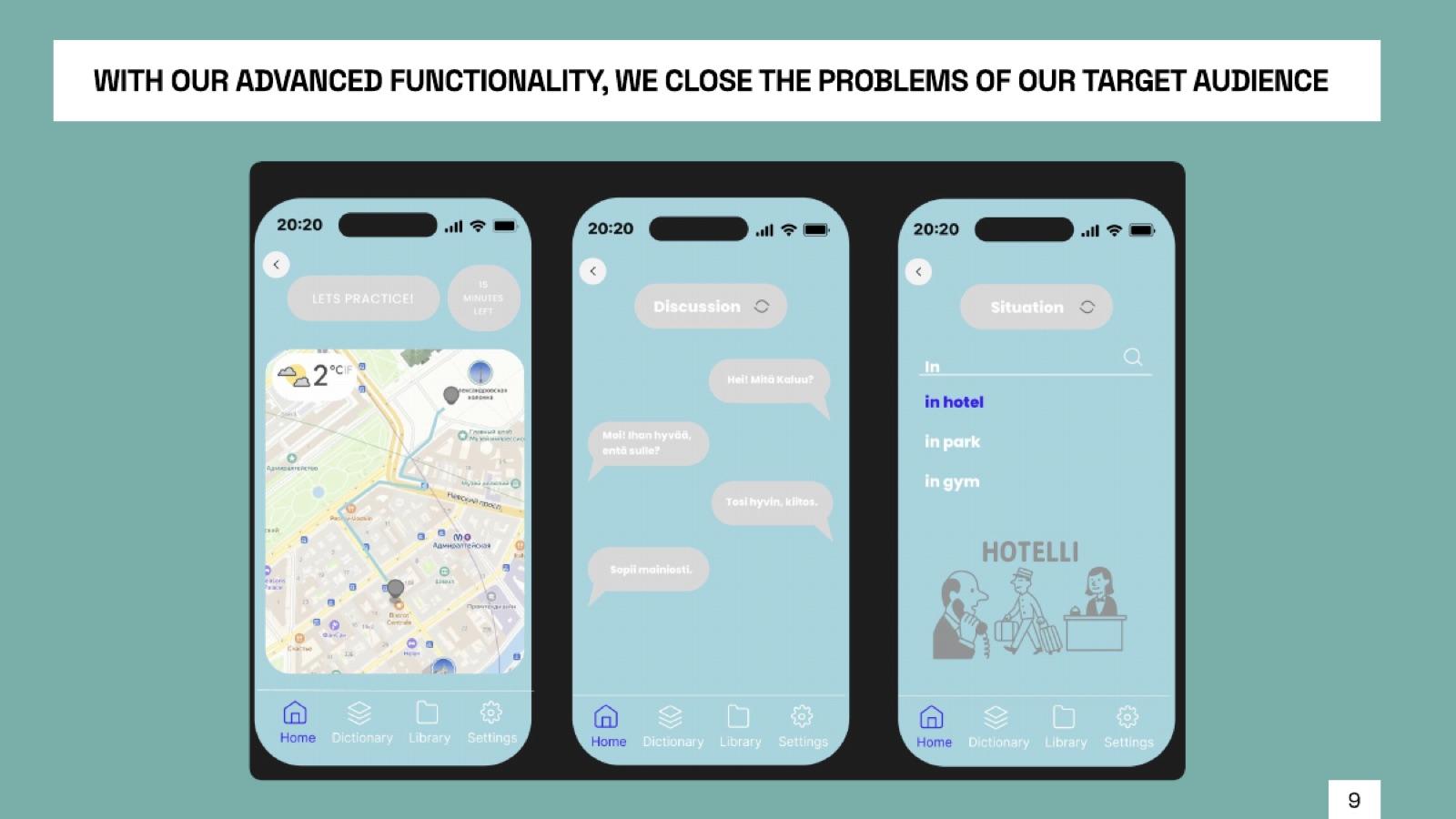
INTERFACE PROTOTYPE
A glimpse of the proposed first version.
The materials show concept screens for a home map and practice entry point, phrase cards, conversation scheduling, dialogue, situations and dictionary. This is a product prototype, not a launched app.


03 / MARKET & FOCUS03
Differentiate through practical speech and context.
The team compared Duolingo, Babbel and Memrise and proposed a direction for PECTO: adaptive speaking practice, real-life scenarios and flexible learning for busy users. This is a hypothesis from an academic analysis, not a validated competitive advantage.
PRIORITIES IN THE MATERIALS
The prioritization materials include spaced-repetition flashcards, audio with pronunciation analysis, progress tracking, short-conversation video and offline mode.
04 / METRICS & VALIDATION
See where learners drop off and what helps them return.
The team proposed a funnel across acquisition, activation, retention, referral and revenue. It is a measurement plan; the materials do not include actual metric values or experiment results.
DAU · MAU · CAC
Sign-up · conversion to paid
Stickiness · LTV · churn · UMUX
Referral DAU · NPS
Revenue · ARPPU
CASE MATERIALS
Research, metrics and prioritization.


PECTO is an academic team project. This page presents team work based on the presentation and research boards. The sources do not break out Daniil’s individual tasks or include validated user testing and actual product outcomes, so these are not attributed to one person. The roadmap, forecasts and business model reflect an academic concept.
SOURCES: TEAM PRESENTATION AND RESEARCH MATERIALS